
But does that mean till then you end up with half baked or half cooked dishes? Not necessarily. There are really simple Indian dishes that anyone can try and make taste good with minimum effort.
Here are some quick facts about Indian Cooking.
- Indian cuisine can be broadly divided into North Indian and South Indian cooking, each distinct in flavour, spices uses, cooking style and main ingredients.
- It’s always aimed at being healthy and well-balanced. Traditionally, all ingredients were used fresh and this increased the health quotient.
- Indian cooking uses ingredients like ginger, garlic, turmeric, green chillies, etc which are said to have medicinal properties. These are crushed and added to the dishes so that the essence and flavour is imbibed into the dish in the right amount.
- Most of the cooking methods in India are such that they retain the nutrients of the fruit or vegetable. This is mostly still practised but lack of time might have made some minor changes to this today.
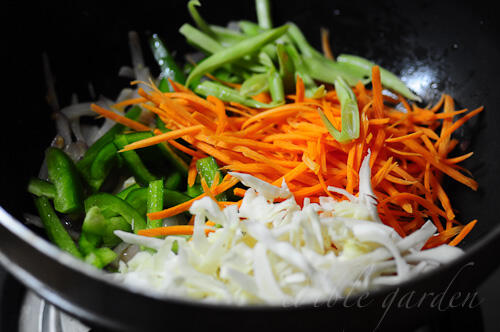
- The vessels used for cooking also make an impact on the final cooking. Traditionally, food was prepared in heavy bottomed iron woks (known as kadai in Hindi). In this vessel, not too much oil or water was required to bring out the flavours of the spices. Food mostly cooked in its own juices under continuous stirring.
In the coming weeks, we will see more of basic Indian cooking techniques, recipes, utensils, FAQs, etc. If you have any feedback or would like to write a guest post, do leave a comment and I will be happy to get back to you.
Cynthia
I am looking forward to more in this series.
Kitchen Flavours
There is a suprise for you in my blog. Click here to know what the suprise is, http://kitchenflavours.blogspot.com/2008/07/fruit-chaat.html
Sig
Great series N... There are indeed way too many myths about Indian cooking... BTW don't worry about grill it event, I know how busy you are... Enjoy the wedding! 🙂
Rosie
Excellent post Nags and I love to learn through blogs such as yours about Indian cooking 🙂
Rosie x
Kitchen Flavours
Happy Independence Day to u dear.
Mallika
Excellent. And how trues. You know that's why I started my blog almost 2 yrs ago. To dispel some of those myths about real Indian cooking.
bhagyashri
A very good post, Nags. Indian Cooking really is misinterpreted a lot. Its generally thought to be very oily or very spicy. But it has a lot more to it than just that. We have so much variety in terms of the spices, herbs, vegetables, lentils, flatbreads, rice & so on.
Looking forward to the next one in this series 🙂
sra
Nags, hi, have been trying to comment on your kala channa - your blog had not been downloading well for the past couple of days. I was surprised that it looked so thick and I'm going to try it one of these days.
jayasree
Good series... Looking forward to ur posts on this series..
LG
Will wait for your future posts...