
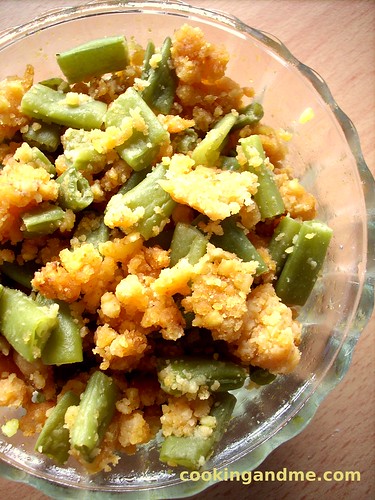
The main ingredients are french beans and toor dal but the recipe is flexible enough to accommodate slight changes. Sometimes I use cluster beans instead of french beans and it works just as well. I have even heard some make cabbage usili but haven't tried this out myself. There are also different and healthier options to cook the dal as opposed to the traditional method of drenching it in oil and telling yourself its healthy cuz it has lentils (which translates to lots of proteins, especially for vegetarians).
Paruppu Usili Recipe
Serves 4
Ingredients:
French beans - 1 cup, cut into 1" pieces and boiled
Toor dal (tuvaram parippu) - ¾ cup
Channa dal (kadala parippu) - 2 tbsp
Dried red chillies - 3 to 4
Hing/asafoetida (kayam) - ¼ tsp
Turmeric powder - a pinch
Oil - 1 tablespoon (depends on the method you use to cook the dal)
Salt - to taste
How I Made It:
1. Wash and soak the toor dal and channa dal (you can put them together) for about 1.5 hours.
2. Once soft, grind this coarsely with red chillies, turmeric, some salt and hing and as little water as possible.
3. The next step is to cook this dal mixture with the beans and we are done. Its really that simple. There are different ways to cook the dal.
(a) Microwave it till almost done, stirring every one minute. It will take about 4 minutes for it to be almost cooked.
(b) Pat the dal mixture with your hand until you have one thick round roti-like disc and then steam it for 3-4 minutes. This won't work if you added too much water while grinding. Not to worry, either follow step (a) or
(c) Pour copious amounts of oil (you need atleast 3-4 tbsp) into a pan and stir-fry the dal mixture. This will take anywhere between 7-10 minutes and is allegedly the tastiest of them all.
I have tried all three methods and found that the steaming method makes the softest and healthiest usili. The microwave version tends to make it a bit dry but its really not that bad at all. The oil-heavy one is the best of course. It has to be, otherwise it defies the rules of healthy cooking and eating.
4. If you already started out in a pan, then just add beans when the dal is almost done and cook for another 4-5 minutes without adding more oil. If you microwaved or steamed the dal, then heat a pan, add 1 tablespoon oil and dump in the dal and beans and stir-blend for about 5 minutes.
Kiran
Thanks Nags, I am going to try this tonight!
Nags
Happy cook - please please feel free to send in something. I will be more than happy to include you in the round up 🙂
Rupa
Hey,
This is a keeper...and thanks for the options. I tried this a couple of times but it needed to be prepared elaborately. Put the dal in the idli cooker etc....hence this dish isn't frequently made...but now your recipe makes it simple....will surely try it soon...
jayasree
I too make usli this way and I also learnt it from my MIL. I don't add chana dal. I think it will add flavor and crunch to usli.
Shreya
Hi Nags, another winner. I am going to try this. I have never made usili, and this being authentic, I cannot fail to come out with good results:-)
Parvesh Garg
love the combi of paupu usli and mor kozhumbu... what say... with some good toghayal... aaaaaah... iprefer it with french beans with ur cluster beans look tender n good
Anonymous
interesting recipe ...healthy too ..that grinding part of dal makes it faster to cook , right ! but what makes me more happy is that therez no ulli hehehe ..will try for sure .
deepa
RAKS KITCHEN
I some how feel that beans and cluster beans are the best veggies for usli,and when I was in hostel,they serve usli with moor kuzhambu,which is also a good combo...:)
Nags
Deepa - my older version had ulli (shallots) but the authentic one is much simpler, thankfully 😉
Shreya - do try and let me know how it came out 🙂
Jayashree - i think chana dal adds an extra flavour and crunch, you are right 🙂
Divya Vikram
HAve heard of this..But have never tried it myself..Thanks for the authentic recipe.